
Submitted by Clive Percy Sayce
The surname “Sayce” originated in England and dates back many centuries, and to see the lineage of our branch of Sayce’s, reference can be made to the in-depth genealogical research done by Douglas Sayce, which reveals that its origins are from the mid-west area of England bordering on to Wales.
The Sayce’s mainly originated from Shropshire and Herefordshire from where they spread to the industrial areas of England and the colonies of the Empire.
The South African Sayce family originated through Alfred Sayce who was born in Bishops Castle, Shropshire, and ended up settling in Woolwich, London in the 1880’s.
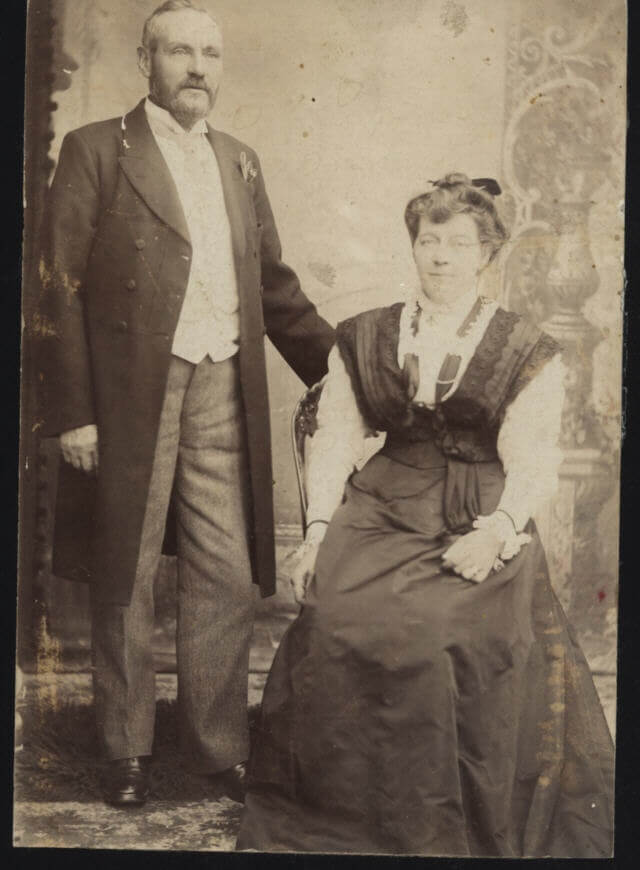
Alfred and his wife, Martha Mulford had two daughters and seven sons, the youngest of which was Percy Cecil
Another of the sons, George, married Marie Unwill and emigrated to Canada. He often returned to London to work during the winter period and to see his family.
I recall my father telling me the story of how all the sons had their own key to the house in 85 Chesnut Road, East Plumstead. One Christmas eve George arrived unannounced from Canada and let himself into the house with his key as a surprise to the family.
Percy Cecil is the first Sayce to emigrate to South Africa, arriving in 1922. Percy was very musically talented and by the age of twelve had become an accomplished violinist and had a good singing voice. However, when he left school, his father insisted he learn a trade as a carpenter in his building company in London. But unlike some of his brothers, Percy rebelled and became an apprentice Fitter and Turner at the Woolwich Arsenal, London, instead of working for his typically Victorian father.
At that time he also stopped playing the violin, much to his mother’s disappointment, but fortunately started again later on. During the First World War, Percy worked for the munitions manufacturer Woolwich Arsenal in London, so he was not conscripted into the army, unlike his brother Ernest.
Ernest was badly gassed in France and returned home shell shocked from which he never fully recovered. He continued to live in London until the early 1950’s. Because of his condition, Ernie occasionally lost his senses and would run off, usually to the local football club grounds. His brothers would chase after him and bring him home.
Fortunately I was able to meet my uncle Ernest whilst in London on my way to Glasgow in 1950. He was delighted to meet Percy’s son and gave me a small wooden suitcase that he had made, which I have subsequently given to my son Gavin.
During World War 1, on Sunday September 3, 1916 Percy went to see his violin, which was being made by a violin maker who lived near Cuffley, Hertfordshire. It so happened that on the same day an important historical event took place and recalling that event was this article which appeared in The UK Mail dated 22/1 /2002 in answer to a readers question.
“In the early hours of Sunday, September 3,1916, Lieutenant William Leefe Robinson, a twenty one year old Royal Flying Corps officer was flying in his BE2c biplane and heading back to his airfield. As he flew over Cuffley, Hertfordshire, he saw a German Schutte–Lanz airship, one of the so called “baby – killers” ( Because they were used by the Germans to bomb London civilian suburbs.) It was caught in the searchlights following bombing raids over Finsbury Park, Tottenham and Enfield in North London. Risking danger from ground shell fire and the crew of the airship firing at him, Robinson put his aircraft into a dive and flew under the airship to within 500 ft. there he emptied an entire drum of incendiary bullets from his solitary Lewis gun, into its belly and side. The airship began to glow and in a few seconds the whole rear end was blazing before falling into a field behind the Plough Inn, Cuffley. All 16 crew members perished . Leefe Robinson received the Victoria Cross (the only VC award for bravery in the UK) from King George V four days later. He died December 1918 after returning to the UK, following appalling treatment in captivity. He was buried at All Saints, Stanmore. A memorial still stands on the Ridgeway in Cuffley. “
Percy told a story behind the above story which is; when the German’s first used airships to bomb London they were filled with hydrogen, which being inflammable were able to withstand the ordinary machine gun bullets used by the RFC ( Royal Flying Corp later called RAF). Secretly an incendiary bullet had been developed and made by Woolwich Arsenal and used for the first time on the above occasion at great risk and with such success that it stopped the Germans using this type of airship, thus saving many civilian lives. Another good reason for the awarding of Victoria Cross..
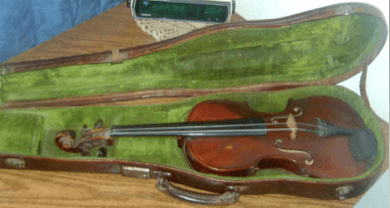 Due to the historical importance of the above event, Percy asked his violin maker William Robson, to inscribe the name “Cuffley” inside his violin. It must have been a fine instrument, as offers were made to buy it when it was entered in a violin competition in London. It was this violin that Percy brought to South Africa in 1922 and enabled him to make a living playing it. He kept it all his life and it is now in the possession of his son Brian.
Percy’s sister Ella lived in London through both World Wars and endured the infamous Blitzkrieg of London city during World War 2. Her son Gerry was drafted into the Military Intelligence and her daughter Olive was a nursing Sister. I also met Ella and her husband Will Paterson and their son, Malcolm in 1950. I stayed with them for a few months whilst deciding where to go next.
Percy’s sister, Lucy and her husband William Cottle were killed in 1945 by a direct hit from a “doodle bug” flying bomb in the latter part of World War 2.
I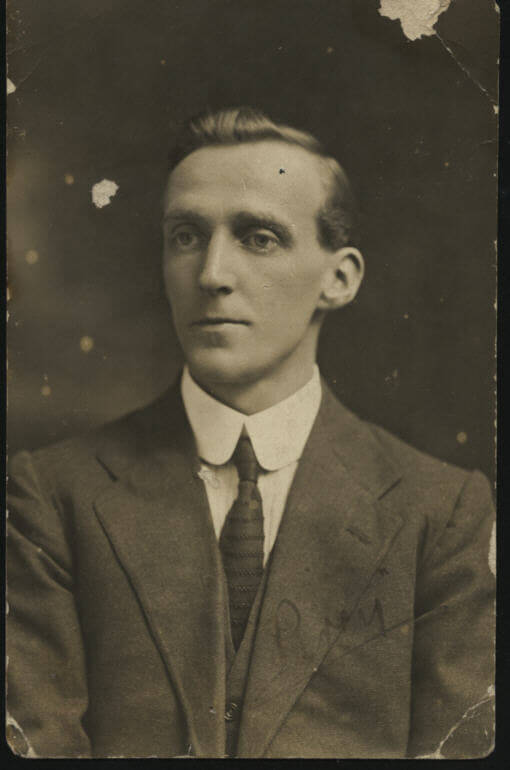 n 1922 Percy decided to leave England and emigrated to South Africa, arriving in Johannesburg in the middle of the ‘general strike’ of mine workers. He found it very difficult to get a job and did manual labour until he had the chance to join a touring entertainment company called the Musical Madcaps playing his violin. After a short while this group folded up and he was once again jobless. Times were hard ! So, he started playing his violin and singing at weddings and functions to earn a living.
While living in Johannesburg, Percy was introduced to Mildred Winifred du Toit, known as Winnie, who also loved music and played the piano and sang very well. She invited him to her home at 16 Samuel Street, Regents Park for a “musical evening”, which was a popular form of entertainment in those days. There he met her parents Joshua and Henrietta du Toit, also her brothers Reuben, Reginald, Alfred and Basil all of whom could play a musical instrument. (Winnie won a gold medal at an Eisteddfod for singing). Percy and Winnie eventually teamed up and become duet entertainers at functions and were married in March 1924 in East London. In 1929 Percy and Winnie had a son while in East London, and named him Clive Percy Sayce.
Hard times continued and they moved to the Transkei (now the Eastern Cape), where Percy toured to various towns showing silent movies (bioscopes as they were called then) as a livelihood, until “talking” movies came into being. He then started his business called “Percy Sayce’s Talkies”, still touring a number of towns in the Transkei and used Idutywa as his base. The original company of Kinekor helped finance him and hired movies to him, which were railed to Queenstown, where Percy collected them every fortnight, returning the previous one at the same time. He also had an arrangement with the Chevrolet agents in East London, to sell him a new vehicle each year, because of the long distances he had to travel. Because of Percy’s work the family were only together every two weeks for one weekend, which was most unfortunate and didn’t provide much family life.
One can only imagine the poor condition of the Transkei roads in the late 1920’s, and Percy had many an experiences getting stuck in the mud and having to strap chains to the tyres to get some grip. On one occasion the left side of his vehicle sank into an unmarked grave near the edge of the “road” and the local people helped to dig it out and used oxen to finally pull it out. After smiles and handshakes all round he went off on his way. It made their day for the friendly Xhosa people.
On another occasion when on the road between Lusikisiki and Port St Johns he reached the Umzumvubu River, which was in flood and the pont was washed away. The steep hills and muddy roads behind him prevented going back, so he expected to spend a cold and wet night in his vehicle. In a short while he heard shouts from the opposite bank and saw lights. It was a group of white townsmen from Port St Johns who were expecting him that night to show movies. They rowed their boats over the river and made a few trips with all the projection equipment on board and took it along the riverside road to the Town Hall (It is still there to this day). They and their families were not going to be deprived of their night’s entertainment !! After a while the flood subsided, the pont restored and Percy’s vehicle retrieved and he proceeded to Umtata a few days late, surprising the people there, as they had heard that the river had been in flood.
Holidays, most times just Winnie and Clive, were spent in Port St Johns to be at the seaside and they stayed at the Windsor Hotel, which is no longer there, and spent time on Second Beach, which is beautiful and provided soft white sand and safe swimming.
As Clive grew older he was sometimes taken on a trip with his Dad as a special treat. The local Black children would run down and open the farm gates when they saw travellers approaching and they smiled and waved and enjoyed their reward of sweets. Like all boys Clive would pretend he was driving and made the appropriate engine sounds and turning an imaginary steering wheel much to Percy’s amusement.
During the mid-1930’s Percy and Winnie were regrettably divorced, and Winnie returned with Clive to Johannesburg and stayed with her parents for most of the time. Winnie never remarried and sadly passed away in March 1950. Winnie was buried in West Park Cemetery, Johannesburg, in grave No.3128 next to her parents.
In 1937 Percy married Eunice May Wilson who had cared for him during a serious illness. They lived in Umtata and had a son there in 1938, naming him Brian Percy Sayce.
At the start of the Second World War in 1939, Percy applied to return to England, but was advised by the British Embassy to apply for a job with Stewarts and Lloyds in Vereeniging, as they were starting production of munitions as part of the war effort. He was offered a job because of his previous experience with Woolwich Arsenal, London. So, in about 1940 Percy sold “ Percy Sayce’s Talkies” to his assistant Eric Lieson. He moved to Vereeninging with Eunice and Brian where he started work at Stewarts and Lloyds. Once again Percy’s life was affected by war.
Early in 1943 Clive, now 14 years old, went to live with Percy, Eunice and Brian in flat No. 12A Jasmine Mansions, Vereeniging. Not as grand as the name sounds, but it was a home and handy for schools, and housing was very scarce at that time, as were a lot of other things such as petrol, tyres, and sugar. In about 1943 the family moved to Meyerton, 18 km outside of Vereeniging, to a bigger house and grounds, but travelling back and forth to Vereeniging become a problem, so they moved back to town after a couple of years.
Percy became friendly with a piano player called Vic Brian, who had a band and played music for local dances and functions. During a conversation Percy told Vic about his ability to play the violin. Vic then coerced Percy into playing it for him to hear, but by then his violin had no strings and was in a neglected state. Eunice then also encouraged Percy to start playing again and had his violin repaired and polished up. After a bit of practice he again became a reasonably good violinist. Percy and Vic enjoyed themselves together ,and Vic eventually persuaded Percy to play a few times in his band. However, this did not last long and the old violin was put back to rest.
During World War 2, Percy joined the National Volunteer Brigade in Vereeniging, like many men of his age and other “key men” did, as well as carrying on with their civilian jobs. (The NVB was an Army unit formed to be on reserve in the event of any threat to the country from without or within.) It became a ritual that at six o’clock every night there had to be silence in the house while the Percy listened to the BBC news on the short wave radio to get the latest on the progress of the War. He was very saddened by the death of his sister Lucy and her husband in London near the end of the war.
Percy played bowls at the Stewarts and Lloyds Bowling Club, which he helped to start up at the newly built Recreation Club in Vereeniging. He was the Chairman and before he retired he was made a Life Member for his services to the Club.
His final position at work was Transport Manager and on his retirement Percy, Eunice and Brian moved to East London. By then Clive had married Nan and they had their first son Douglas and stayed in Vereeniging. Percy and Eunice also lived for a while in Port St Johns where he became Chairman of the local Bowls Club and insisted Brian and Clive also become members, very likely to increase income from their annual fees. But it worked out well, because to his delight he and his two sons, together with another player, as members of Port St Johns Bowling Club, competed in the 1966 South African Bowls Championships in Johannesburg and did rather well. Later on Percy and Eunice moved back to live in East London.
Sadly, Percy Cecil Sayce passed away in 1968 and was cremated at the Cambridge Cemetery in East London, Eastern Cape, RSA.
Life in the Victorian age could not have been easy, but the family managed well enough as all the sons had jobs as artisans, but it must have been hard for the Mothers bringing up such large families, as was quite usual in those bygone days.
His parents would have been proud of their son Percy, as he was good man, noted for his complete honesty, integrity and belief in fair play, with high intelligence and a keen sense of humour. He gained the respect of his peers and superiors, was kind and highly principled, and a man of his word. He often came across as a being “cold” and didn’t find it easy to show affection, but inside he was proud of his family and loyal to his country of birth and adoption.
As well as playing the violin, Percy was always keen on sport and played soccer, and cricket at which he was good enough to play once for the County Kent, but he dropped a catch and was not selected again. In later life in Vereeniging he took up bowls and become very good at it. He was also a good bridge and chess player.
Clive was born in East London, South Africa on 6-Feb-1929, but the family lived in Idutywa in what was then known as The Transkei, now part of the province of the Eastern Cape. Clive grew up and went to school there until he was about 8 years old. Unfortunately at this time his parents were divorced and Winnie and Clive went to East London for a year, then to Johannesburg to stay with his grandparents, the du Toit’s, in Regents Park.
For various reasons Clive went to a number schools, the main ones being Marist Brothers College as a boarder for a year and then Witwatersrand Technical College, Braamfontein also for one year. During this period of his growing up his grandparents moved to Honeydew farm, which he enjoyed and learned about life on a farm, riding horses and other experiences while living in the countryside. It was while at Wits. Tech. in 1942 that he realised his love of engineering, physical science and chemistry. In 1943 he felt the need for a father and after a disagreement with his mother he went to live with his father, Percy and his wife Eunice and their younger son Brian in Vereeniging. He transferred to the Vereeniging Technical College, where he passed Matric In December 1944 at the age of 15, with distinctions in Mathematics, Science and Engineering Drawing and Design.
In his early teenage years Clive was involved in The Boy Scouts movement and became Chief Scout of his Troop, played cricket and football, and was a choir boy at the Anglican Church until he had a big fallout with the Minister about his father being a divorced man.
On 6 Feb 1945 he was contracted as an Apprentice pattern maker in the foundry at Stewarts and Lloyds, which he was fortunate to get as his father worked there, and jobs were scarce after the end of the war. In 1949 Clive won the Best Apprentice award, probably because he had continued his studies at night school and obtained Advanced Technical Certificates 1 & 2 in a number of subjects.
At the age of 18 Clive was called up to do his compulsory National Army Service in the 1st Anti-Aircraft Regiment based in Vereeniging. Hated it, but survived and learned a lot about life having to attend “camps” each year for five years. He also continued playing soccer and cricket.
On 5 Feb 1950 he became a journeyman pattern maker and moved to the Benoni to where he was offered a job to by the ex-Foundry Manager under whom he worked as an apprentice, and then to Port Elizabeth so as to have a better chance to get a sea passage to England. It was Clive’s goal to go England, which he longed to see having heard so much about it from his Dad. Clive, with twenty pounds in his pocket, sailed from P.E. on the Rochester Castle cargo ship in June 1950. In London he stayed for a while with his aunt Ella, uncle Will and cousin Malcolm. He then spent the first two weeks and all his money, twenty pound, seeing the main sites in London, before getting a job. The horrendous bomb damage from the war was still evident to see, particularly in the East End docks area. Food rationing was still in force in Britain at that time and a Ration Book had to be issued to one on arrival even though World War 2 had ended in 1945. Clive loved his Aunt Ella, who was very kind to him. He got on well with his cousin Malcolm and they have kept in touch over the years, and last met at Gatwick Airport in 2007.
In September 1950 being footloose and fancy free, Clive decided to move on from London and went to Glasgow and worked as a Patternmaker for John Brown Shipbuilders, where the famous ships the Queen Mary and the Queen Elizabeth 1 were built. He learned a lot more about his trade and grew as a person still being only 21 years of age. It was difficult to get suitable lodgings and eventually stayed as a lodger with a small family in Bath St. in the centre of Glasgow. While in Glasgow he got to know and like the Scottish people, but the weather in winter was harsh.
This is an extract from a story Clive told his son after Douglas had rejuvinated Clive's tool box - "In June, 1950, I was 21 years old, when I arrived in Hull, England by ship and caught a late train to London, because of dock strikes at London harbour. I had travelled on a cargo ship, the Rochester Castle. I recall, when I arrived at Earls Court Station at about 11 o’clock at night in 1950, a porter lifted my tool box onto a trolley and said “What have you got in here, son...Gold?” He was so strong and experienced that he lifted it by himself, full of tools, then my suitcase. A London Bobby strolled up the empty station platform and realised my predicament. He then instructed a taxi driver to take me to my Aunt Ella’s house in Charlton for one pound, in spite of Charlton not being in his territory. The Bobby saw I was from South Africa and had met some of South Africans during WW1. South Africans were well thought of then in the UK. My Aunt Ella was still up at after midnight when I arrived, because she had told her family 'Clive will be here tonight'. My uncle Will and cousin Malcolm were asleep in bed. Things were tough in those days and war rations for food and clothes were still place."
One Saturday night in Glasgow at The Kelvin Halls ballroom dance hall Clive met and danced with a lovely young girl, Nan Duncan. Clive asked Nan if he could see her home, she turned him down, but did let him walk her to the bus stop to her home in Sandyhills. On the way to the bus stop, they made a date to meet “under the clock” in Renfield Street the next Saturday evening and go to a movie. All went well and they started dating, going to various ballroom dance halls, and visiting places like Loch Lomond, Callander (walked in the snow) and Edinburgh. They fell in love and got engaged in April 1951. Not having much money Clive decided to return to Vereeniging, South Africa in order to save some money. Nan accompanied him to London before he departed by ship then she returned to Glasgow.
On arrival in SA he restarted work at Stewart and Lloyds as a Draughtsman and waited for Nan to join him. Nan arrived in SA in November 1951 and also managed to find a job. Nan was very homesick and things turned out badly with Clive’s stepmother. So Nan moved into a boarding house. Nan and Clive saved hard and were married 14 April 1952 and were fortunate to rent a small flat. A few years later they moved into a house of their own in Three Rivers, where their first son Douglas was born in 1954. In 1956 their second son Ronald arrived, followed by their third son Gavin in 1960.
It was during this period that Clive was promoted to Chief Draughtsman in a new Tubular Structures Dept. and eventually became Manager. However, in 1961 he was offered a better opportunity as Sales Manager with a GKN company, Twisteel Reinforcements in Johannesburg, at a grand salary of 150 Pound per month and a Company car. So, the family had to move and Mondeor was chosen as their suburb to live in, where they eventually had a nice house built with four bedrooms, large garden and a lovely view. They had their fourth son Ian in 1963.
Mondeor was an ideal suburb in which to bring up children and they had a lots of friends, freedom and fun things to do. They became known as “the Sayce Boys” The size of the family now put holiday hotels out of reach, so Clive decided to design and build a caravan. After six months of planning and hard work it was successfully completed in 1966, with indispensable help from Douglas and Ronald, which taught them a lot about the use of tools and working with their hands. Nan made the bed covers and curtains. Having a caravan enabled the whole family to have holidays in many far places such as The Kruger Park, Kimberley, Fish Hoek, the Wilderness, East London, Nelspruit, the Drakensberg Mountains, the Natal Coast and many places in between. It was a fun time and all enjoyed it, except for the chores, but they got done too.
Clive’s career with GKN progressed well with hard work and loyal support from Nan and in 1968 he was promoted to Sales Director, then in 1974 he became General Manager then Managing Director in 1976 and joined The Board of Directors of GKN SA. They decided to merge Clive’s company Twisteel, which was profitable, with another one of their companies, Mills Scaffolding, which making losses, and Clive was appointed as Managing Director of GKN Millsteel in 1978. Nan and Clive decided to move into a townhouse in Bedfordview, because by this time Douglas had married Karen, and Ronald had left to work in Cape town and later married Jenni and they emigrated to Australia. Gavin was doing his Army Service training and later went to Wits. University and Ian was in Matriculant at Jeppe School for Boys.
During the 1970’s and early 80’s South Africa was going through very difficult times politically and economically because of the Apartheid system and International sanctions started being applied by major countries such as Britain and the USA. In 1984 Clive was made Chairman of GKN South Africa with the brief that if certain criteria were not met, the Companies were to be sold or closed down. Sadly the final result was that all GKN SA Companies ceased to exist by 1988, except for Chep. This was a very difficult and traumatic experience for Clive and when the job was done, he was glad to retire on pension in March 1988 after having been with GKN for 27 years. Retirement required an adjustment for both Nan and Clive, but all went well and he occupied himself with interests in bowls and serving on various Committees, and holidaying with Nan in Scotland, Europe and Australia, visiting family.
Their next move was to a retirement village called San Sereno in Bryanston, from 1991 to 1996. Ian and Alison had married and decided to emigrate to Brisbane, Australia in 1992.
In 1996 Clive and Nan moved from Johannesburg to the warmer climate of Uvongo, Natal. Douglas had earlier that year moved to Shelly Beach with Karen, to work for Coastchem in Port Shepstone. Clive and Nan's main activities were travelling overseas, keeping in touch with family, watching TV and bowls.
In April 2002 Clive and Nan celebrated their 50th wedding anniversary at the Estuary Hotel preceded by a sea cruise on the Monterey, with all four sons and their wives and granddaughters Skye and Chloe. Some also visited the Hluhluwe Game Park. The anniversary was a wonderful occasion, with family and good friends.
In January 2008 Clive and Nan moved to The Village of Happiness, Margate, which provided them with better security and other facilities for their age group. In June of 2008, Doug & Karen took Clive and Nan for a weekend holiday to Port St Johns, where Clive was able to visit the old Town Hall in which his father Percy had showed movies in the late 1920's.
Now both in their 90's, Clive and Nan have bravely had to deal with self-isolation during the Covid-19 pandemic
Submitted by John Sayce
January 1st 1835 would have been a cause of much celebration for everyone living in Bishops Castle. The previous year’s harvest had been good, as 1834 had been the warmest on record since records started in 1733 – a temperature not beaten until 1949. In Westminster, slavery had been finally abolished in the British Empire.
Another kind of record was set as Great Britain had had 4 different prime ministers in a year and the Houses of Parliament were burnt down! In Church St., John and Abigail Sayce had every reason to celebrate as well - it was their golden wedding- an event almost unheard of when life expectancy was around 45 years.
John was born in Bishops Castle in 1752 and probably attended the school established there by Mrs Morris in 1737. It catered for both boys and girls who learnt reading, writing and arithmetic with the girls getting additional training in sewing and needlework. Abigail was brought up in nearby Clun. They were married in 1785 when John was 33 years old and Abigail 29. Six children, 3 boys and 3 girls were born between 1786 and 1801. As with many families at that time, they had lost one girl, Sarah when she was two months old and another Ann who died in 1830 aged 42 years.
As the new year started, they could have been surrounded by a daughter and 3 sons; Morris, John and William. Susannah, their daughter remained unmarried, and lived with her parents until their deaths. Afterwards, she seems to have stayed with various relatives and friends until her death in 1873. As many as 16 grandchildren might have attended the celebrations as they all lived within a 25- radius of Bishops Castle. An additional 12 grandchildren were born in the following years, with the last one, Florence, dying more than a hundred years later!
John appears to have been very actively involved in town life being appointed a Bailiff of the Corporation of Bishops castle in 1827, when the local newspaper declared that ‘last week a sumptuous dinner was given by Lord Clive on quitting the role of Bailiff when John Sayce was sworn into office’ The Corporation had been established by charter in Elizabethan times and allowed 12 burgesses to run the town together with a Bailiff and Recorder mile who were responsible for administering justice. John had been a burgess for many years and seems keen to ensure that his sons were part of the chosen few with all three sons elected as Burgesses between 1804 and 1823.
The Corporation was responsible for administering justice and even had its own prison cells below the Town hall. However, this system was subject to corruption as Bishops Castle returned 2 MPS to parliament and was known as a ‘pocket’ borough being in the pocket of the local nobility. Lord Clive was the son of Clive of India and most of the town was beholden to them for work and preferment. There was only 1 known Burgess at this time that refused to take their bribe for votes. In 1830 at the age of 78 John describes himself as the ‘Recorder of Bishops Castle’ which says much about his position in local society.
We know nothing about the house they lived in in Bishop’s Castle but we do know a lot about Church St. which was the main street in the small town of 2,000 people. They certainly won’t have been short of a drink as they had 6 public houses and 3 beer sellers as neighbours! John and Abigail were retired and living off their own savings. In 1791, the Universal British Dictionary tells us that Bishops Castle has 4 gentlemen, 2 clergy, 3 physics and 3 attorneys. There are 30 different traders mentioned – drinking seems to be of utmost import with 17 people being noted as maltsters or publicans / victuallers. This is also a world of some prosperity as there are 8 butchers and 3 grocers and chandlers. As you might expect all the building and working trades are mentioned, but interestingly one’s appearance seems to rank highly for the residents. The town has 3 shoe-makers, 2 haberdashers, 2 mercers, 2 milliners, 2 glovers, a stay-maker and a wig manufacturer. And one land surveyor – John Sayce!
Just a year later Abigail died, and on her tombstone, she is described as the amiable and beloved wife of John. Not long afterwards, he moved with Susannah from Bishops Castle to Weir Cottage on the border with Wales. They moved there as it was just a quarter of a mile from his son John, and family who were living on a farm at Skyborry. We can get some idea of John’s cottage from a rental notice placed by Morris and William Sayce in the Hereford Journal newspaper dated January 1832
A Comfortable COTTAGE, called The Weir containing a Parlour, Kitchen, Back-kitchen, and four Bed-rooms, with other Conveniences ; also Stable, Cowhouse, Garden, and three Acres of good LAND, pleasantly situated on the Banks of the River Teme, commanding a beautiful prospect, and within half mile of the Market Town of Knighton.
Trade directories of the time show that John and his sons were classed as part of the gentry. Indeed, in the 1841 census, John and Susannah had a servant living with them, a state of affairs that all 3 sons were used to throughout their lives. We are lucky to still have a copy of a letter that John Sayce senior wrote on October 16th 1841 in beautiful copperplate handwriting.
‘If thou barest slight provocations with patience, it shall be imputed unto thee for wisdom; and if thou wipest them from thy remembrance, thy heart shall feel rest, thy mind shall not reproach thee’ - A quote from the Economy of Life published in 1758. If only his son John junior had paid attention to these words!
Nine months later in June 1842, John (aged 90 years) died with the death certificate stating that it was due to decay of the arteries. We lose track of Susannah until the census in 1851 when she is living with her brother William in Abergavenny. She dies in 1873 in Clun. John and Abigail would have known that all 3 sons, after growing up in Bishops Castle, had successfully launched into well paid work, married and started families. Morris and William remained close, both living in Kington, Herefordshire and working together in partnership for many years as surveyors and engineers. Later on, they became involved in civic affairs. Their other son, John and family seemed to have taken a different course in life.
How did John end up living on the farm at Skyborry? We know that John married Margaret Morris in July 1817. She was born and brought up with her brother James on the farm owned by her father Richard Duppa, until his death in 1818. He wrote a will in January 1817 appointing Margaret as his executor and bequeathing Skyborry, the farm and cottages to her. Subsequently, she and John had 4 children; Richard born in 1818, Susan Anne born in 1820, Robert born in 1821 and Margaret in 1829. Unusually for parents of this age, all their off-spring grew into adulthood. The first glimpse we get of John’s character is from a cutting from The Times and several London and provincial newspapers in May 1825.
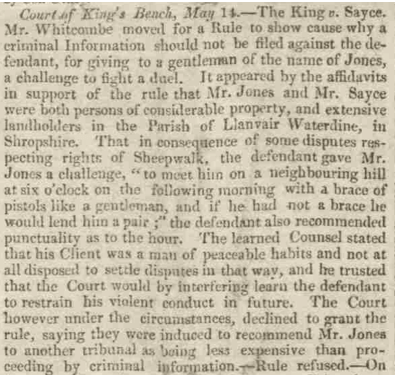 We know that the Mr Jones referred to in this report is Michael Jones of the neighbouring farm, Panpunton, who we will meet again. Given the lack of a local police force, it is perhaps no surprise that local citizens in 1828 formed ‘The Knighton Association’…...’ for the prosecution and bringing to justice of all persons committing felonies and offences upon or against our respective persons or property’ – and two of the signatories? Mr Jones and Mr Sayce!
John and Margaret’s daughter Susan Anne was married in 1838 when she was just 18 years of age and needed her parents’ permission. This was extremely young for a woman and maybe speaks of how she wanted to leave her parents’ domain. Interestingly she married a farmer, John Smith from Calver Hill outside Kington- where her cousins, uncles and aunts were living and could offer support. We lose contact with the Smiths but do know that Susan was deceased by 1875. If the court in London had hoped that John would ‘restrain his violent conduct in future’ they were sadly mistaken. The Shrewsbury Chronicle of August 1845 carried a short report of an incident in November 1844.
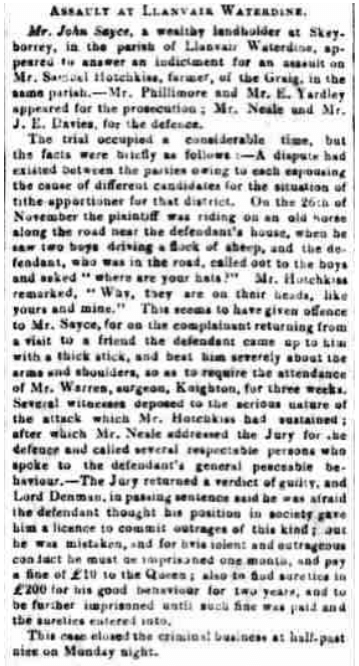
John didn’t exactly help his own case. Witness Thomas Tudge said that a few days after the attack, he had met John in the Chandos arms, Knighton. He stated that ‘the defendant had a stick in his hand and said to the witness “this is the stick, Tudge, that I gave it to the damned rascal with” Cross-examined in court by an attorney, John said then said that Sam Hotchkiss ‘wanted to ride over him and he gave him a good trashing; he deserved it much harder and if he had had a larger stick, he should have had it’. John’s lawyer must have addressed the jury with a certain foreboding but ‘urged on them the impossibility of a little man like the defendant attacking Mr Hotchkiss who was a man large enough to make a New Zealand Chief’. ‘The jury only adjourned for a few minutes before returning a verdict of guilty.
John’s friends weren’t going to let it rest there. No, they put an advert in the local paper saying they were going to hold a dinner in honour of John after he had finished his sentence! So, a local Journalist reported that
‘A large party, comprising most of the agriculturists in the neighbourhood of Knighton, and many other influential resident gentry, dined together on Saturday last the 30th ult. at the Chandos Arms Inn, on the occasion of their presenting Mr. Sayce with a piece of plate in testimony of their continued respect for him, notwithstanding the late proceedings instituted against him by Mr. Samuel Hotchkiss for a common assault…..A very excellent dinner and dessert were provided, and during its discussion the company were enlivened by the Clun brass band…..The Chairman then rose to propose the health of their guest, Mr. Sayce, to whom he wished long life and prosperity. (Hear, hear, and applause.) They would drink his health as a good husband and a good father, a kind neighbour, and an excellent agriculturist, and he presented him with the tankard he held in his hand more as a token of their respect than for its intrinsic value……..Mr. Sayce rose and said he wanted words to express the feelings which overpowered him; he felt highly honoured by that day’s proceedings, and was grateful for the kindness that had been shown him, which he could never forget’
There were numerous toasts drunk and more and more speeches as the evening drew on!. ‘It was Mr. Green's opinion that the proceedings against Mr. Sayce had been characterised by too much personal malignity………Morris Sayce rose and said, that seeing the advertisement of that day's meeting, called to his recollection that he had a brotherly feeling,—he felt proud to see the company that had assembled to honour his brother…….The Chairman then proposed the health of Mrs. Sayce, which wished to drink out of the tankard, and after speaking highly of her amiable qualities, said that whatever were their feelings over that cup, the feelings of Mrs. Sayce were of a far higher nature.‘ Having started at 3pm, the dinner finished at 11!
This report must have inflamed the feelings of Samuel Hotchkiss as he immediately took to writing a public repost.
‘I had hoped that the decision of Lord Chief Justice Denman in my favour would have been sufficient to set the matter at rest with everyone who had any respect for the laws of the country……..The long list of squirearchy may lend those at a distance to suppose that the defendant Sayce was much respected by his neighbours, that he has been a most persecuted and injured man.’ Mr Hotchkiss further comments that most of the attendees were ‘composed of farmers at some distance’ rather than local people. ‘Is any man to be waylaid and in the most cowardly manner attacked, disabled and beaten at night and then when he seeks the protection from the law to have it publicly declared that he does it out of malice and revenge?... That a man guilty of one of the most atrocious attacks should be honoured by a public dinner……is in fact a premium upon him and holds out to others by adopting a similar mode of conduct, the hopes of a similar reward to hand down to posterity as a pleasing remembrance of their misdeeds’.
John and Margaret’s decision to move from Skyborry in 1848 gives us an insight into the wealth that they had managed to accumulate. Skyborry was an estate of ’400 acres of superior quality land with a farmhouse and buildings of superior order’, although the flyer notes that with ‘a moderate outlay the farmhouse may be made a desirable residence’! And who is making these statements, if not his brother Morris and nephew Edward Morris Sayce both of whom were land agents!
‘GREAT AND IMPORTANT SALE Of 129 Head of Cattle, 30 Horse, Mule, 2 Sows and 19 Pigs, the property of Mr. John Sayce, who has sold the Estate, and being about to retire from business, he has instructed EDWARD MASON TO ANNOUNCE THEM FOR SALE BY AUCTION…… The celebrity of Mr Sayce’s stock of cattle and horses have been such, for many years past, as to render any further remark upon them unnecessary, except that the cattle stock…are fully equal and in some respects superior to any ever before bred by him; and the young horses are of high promise as hunters and carriage horses being well-bred, of great size, fine of form and having grand action.’
We will never know if this notice is just a salesman’s hyperbole, but there are other reports that do suggest he was a good breeder of livestock. In 1836 ‘Friend of Agriculture’ from Ludlow writes ‘from a feeling that John Sayce’s exertions in bringing his stock to such perfection ought to be made public’. John was also a keen supporter of the Knighton Races regularly making a substantial contribution to the funds.
However, the statement from Mr Mason that John was about to retire from business turned out to wide of the mark! John, Margaret and their 3 adult children now moved to live and work on 2 farms next to each other in Quatt Malvern near Bridgnorth- a village about 40 miles distant. Was this an opportunity to make a fresh start? If so, John had a stark reminder of his unfinished business when he appeared before magistrates in 1849.
‘Mr. John Sayce, farmer, late of Skyborry, appeared to answer to a summons of Mr. Michael Jones, present surveyor of roads for Llanfair Waterdine. It appeared that there had been two legal meetings called…. for the purpose of hearing the surveyor's accounts read, and having them passed. Mr. Sayce, the retiring surveyor, did not attend either of them ; previous to Mr. Sayce leaving the neighbourhood, however, he called a meeting in the latter end of April to pass his accounts, and stated his expenditure to be £16-12-0d., which was objected to (by) the landowners present, on the grounds of it being an overcharge and no bills being produced to confirm the statement that the work had been executed. In consequence, the present surveyor applied to the Magistrates, who recommended he should employ surveyor, Mr Jackson of Clun, to value the work done by Sayce. Jackson's estimation was £6-I-3d. After the witnesses had been examined Magistrates ordered Mr Sayce to pay the balance of £9-14-10d and the expenses back to the present surveyor which he had entered in his books They reprimanded him for doing the team work and labour himself, the other inhabitants not having a chance of working on the highway and for not passing his accounts within 14 days of Lady day for which he had subjected himself to a heavy fine.’ There is a strong possibility that this Michael Jones was the neighbouring farmer whom he had challenged to a duel in 1825!
But what about John and Margaret’s 3 grown up children who remained with them on their new farm at Lye Hall? Richard was the eldest with the 1851 census form showing that he was farming 2 nearby farms occupying 229 acres. Robert is recorded on the 1841 census as being a land surveyor like his paternal grandfather and then as a surveyor and civil engineer in the 1851 census. I can find no newspaper cuttings or references to him practising these trades which is unusual as he would almost certainly have had to advertise to gain work in a new location. However, a report from the Bridgnorth Magistrates court in June 1851 does suggest he was an employer. Robert was cited for assault – ‘Pat, who was in the employ of the defendant, to whom he became very abusive in consequence of some dispute having arisen in respect of wages and Mr Sayce threw him into a pool of water. Pat was rebuked for his abusive conduct towards his employer and the latter was fined 2s 6d. and 13s 6d costs for the cold water affair.’ Margaret would have been 19 years old when they moved and probably helped her mother in the home and farm.
The Sayce family had hardly settled down in their new farms, when a decision was made that would profoundly change the lives of all of them. The Staffordshire Advertiser carried an auction notice in February 1853, saying that Mr Sayce was selling up and moving, so offered his livestock of sheep, pigs and poultry for sale on the first day. Then the following day this household furniture was to be sold.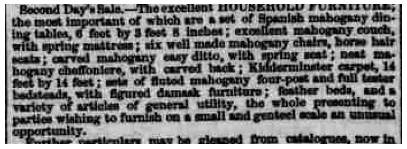
So where might the Sayce family be moving to less than 4 years after they uprooted themselves from Skyborry? The answer is to be found in the passenger lists of the S.S. Asia, a Cunard steamship, the largest ever built on the Clyde when it was launched three years earlier in 1850. This 2200 tons ship was luxuriously appointed with a degree opulence not often seen. It left London on March 22nd 1853 with the Sayce family on board and 4 months later at the start of August, she dropped anchor outside Port Philip in Victoria, Australia. We can imagine the passenger’s relief at having arrived safely after such a long and hazardous sea voyage. For some of the younger men, this seemed like an opportunity to enjoy themselves as seen in a contemporary report.
‘4 persons on Thursday left the ship ’Asia’ and went to Brighton in a boat. They stopped there that night and left in order to return to the ship at 9 0’clock on Friday morning. Owing to rough weather they could not reach the ship and continued beating about until 2pm when they were only 1 mile from St. Kilda; they attempted to run the boat up but in doing so they capsized and three of the four were drowned, notwithstanding that assistance was promptly rendered to them by Waddell and Francis, Mr. Mooney of the St. Kilda hotel and Doctors Van Weinholt and Holt. Dr Wilmot held an inquest on the bodies on Saturday, when a verdict in accordance with the above facts was returned. The name of the survivor is Alfred Jason, the names of the deceased were Robert Sayce, Capleton and Lampton.’
Just 8 weeks later on September 28th, the other 4 members of the family had a great reason to celebrate as 24-year-old Margaret Sayce married a physician living in Victoria named Thomas Annesley. The ceremony took place at Christ Church in Geelong, a location where both the Annesleys and Sayces settled down in to live in. He was 48 years old, having been born in 1805 in Portadown, Ireland. We know that he trained as a doctor in Ireland before emigrating in the 1850s. However, he was not on the same steamship as the Sayces! So why did the Sayce family emigrate as they undoubtedly had a comfortable life in Shropshire? We have no clues from the paper work, but there was a demand from the colonies for young women to be brides as there was a surfeit of men. Even so, it would have been unusual for John, Margaret and the 2 boys to have relocated as well to Australia.
Just over 9 months later in July 1854, Margaret and Thomas’s first child, Thomas junior was born in Chiltern, Victoria, a small pioneer settlement about 150 miles North East of Melbourne. By June 1856 they had returned to Geelong to live at Foymount in the Barrabool hills which is described as ‘a handsome two storey building on the main thoroughfare’. The local paper continues ‘Dr Annesley is a North of Ireland man and bears the reputation for being clever. His connection with the hills is not yet of a prolonged duration, but in his limited sojourn has won for himself a good opinion.’ Anne Elizabeth, their second child was born shortly afterwards in November 1856. The family were to remain at Foymount, set in 84 acres of land until Margaret’s death in 1882.
As for the other 3 members of the Sayce family? We have no confirmation of their living arrangements from 1853 until 1862, when Richard dies of chronic whooping cough in the home of his parents who were also living in the Barrabool hills. Perhaps John and Margaret would now have to chance to enjoy the company of their 2 grandchildren as they lived in such close proximity to each other. John was widowed in 1875, when Margaret died of dysentery and old age, at the age of 80. John Lived on for another 4 years dying when 88 years old, nearly the same age as his father. His death certificate states that he had had a paralytic seizure in 1877, meaning he would probably have needed care from his daughter and family.
Margaret Annesley died in 1882 at the relatively young age of 53 years having had ‘heart and lung disease’ for the previous 5 years. But, you ask, what about the Sayce ‘wealth’ mentioned in the 1845 court case? No sign of a will for either John or Margaret Sayce, but any monies they had would surely have gone to their daughter Margaret, who left the moderate sum of £510 in her own will!
created with
Website Builder Software .